


The Comeback of Supersonic Planes, your Top Choice to Avoid Turbulence
How much would you pay for a supersonic flight? Let’s say it saves you 2 hours in your next transatlantic trip, or maybe 3. Would you pay 50 % more than for a first-class ticket in a subsonic plane?
The answer to this question was already given to the Concorde: no, I am not willing to pay that much. So why should we hope for the comeback of supersonic planes? Because the day a company manages to make them profitable, that profit could be enormous (a recent example of a similar challenge was the global race to find a Covid-19 vaccine).
With this in view, we can be sure that there will always be companies working hard to develop such plane. Recent advances in aerodynamics, materials and engine propulsion are pushing this goal even closer.
So why did the Concorde fail to be profitable?
The Concorde was built during the race for technology supremacy during the Cold War. Profitability was surely on the table, but it wasn’t the top priority. The main one was to win the race, extra costs were taken by the governments. The US failed in its development of the Boeing 2707 in an unrealistic attempt to reach Mach 3 (three times faster than the speed of sound). The Soviet Union won the race with its Tupolev 144, which reached supersonic in June 1969. Five months later, in October of the same year, the British-French Concorde reached the same feat.
Eventually, as we all know, the war was won by the West. The Tupolev was retired in 1978 after several crashes and critical design flaws. This left the Concorde alone as the “Queen of the sky”, until its retirement in 2003, purely due to economical reasons.
Other reasons have been listed for the retirement of the Concorde. Environmental… but, sadly, since when is this an issue as long as there is profit to win? Safety concerns after the fatal crash from Air France in 2000… but what about its previous 30 years without a single accident?
The technological level in 1969 just wasn't ready for supersonic passenger flight: huge fuel consumptions, which got even worse after the oil crisis in 1973, loud sonic booms, which forced it to be banned to fly over land, etc. These aspects were over-looked in favor of winning the race.
Last month, the biggest hope for new supersonic flight, Aerion Supersonic, announced a complete shut down since they didn’t manage to find a profitable solution. This came after 18 years of research and 93 orders. Still, the US government didn’t take over the costs, and this is what should have happened to the Concorde project.
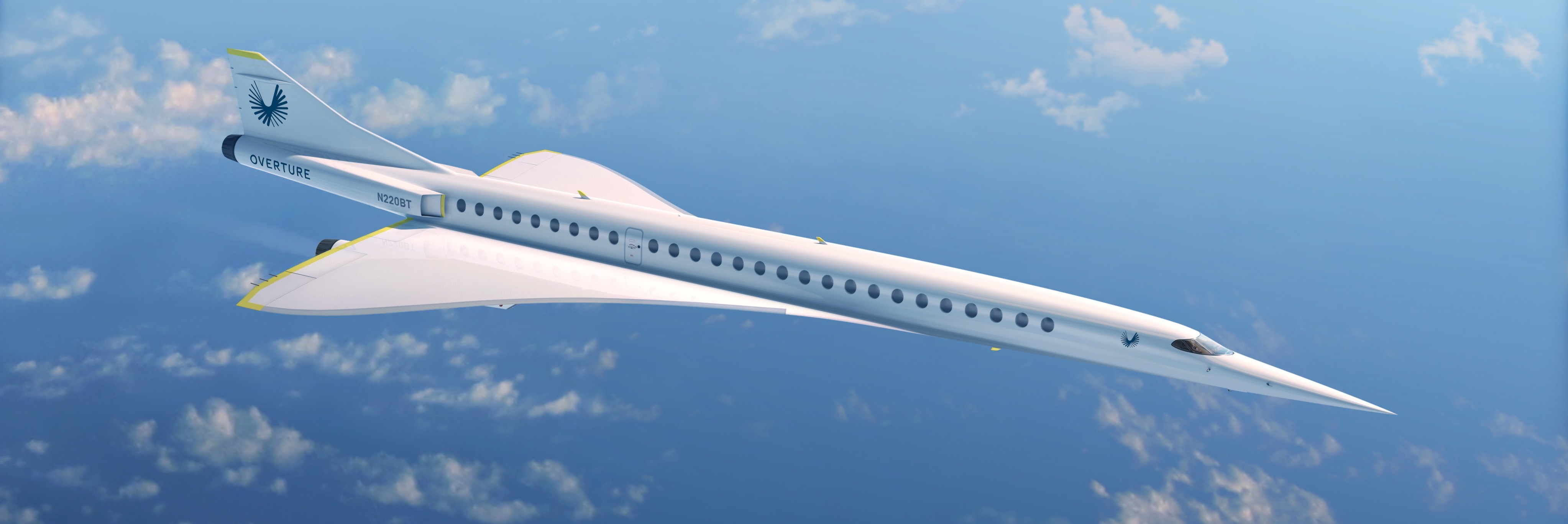
Other companies such as Boom Supersonic, Spike and Exosonic are still trying to develop new supersonic passenger planes. It could be that none of them make it. But if they do, it will certainly be because they found the key for profitability, not due to being massively subsidized. By now, Boom Supersonic has signed 14 orders of its Mach 2.2 Overture with for United, planned to be delivered by 2029. We will see if they make it.
But how will it feel to fly supersonic when hitting turbulence? The faster the plane goes, the larger the forces from turbulence are felt inside. Think of it as driving a F1 car at top speed over a road bump.
Fortunately, the Concorde and Boom Overture cruise at about 60,000 feet (18,000 m), much higher than the 38,000 feet (11,500 m) of subsonic airliners. At this altitude there is almost no weather, nor turbulence. All clouds are below, jet streams are far down… So you can expect this part of the flight to be one of the smoothest you’ve taken. The ticket price will most likely deserve it.
Inevitably, the plane will have to cross the turbulent part of the atmosphere during climb and descent. This is done as subsonic speeds.
One of the main factors affecting turbulence-plane interaction is the wing loading: plane weight divided by wing surface area. The larger this value, the smoother the flight. Here there is not much difference: the wing loading of the Concorde was 500 kg/m2, very similar to the Airbus 320 and Boeing 737-800.
One difference will be on the stiffness of the wings. Subsonic planes are designed with thin wings which can flex and absorb part of the turbulence force. The stiff wings of the Concorde or the Boom Overture, needed to maintain the integrity at Mach 2, will not provide this smoothing effect. Therefore, turbulence should be felt stronger.
On the other hand, the Concorde had roughly twice as large moments of inertia in the yaw and pitch axis than subsonic planes. This means that it took twice more energy (or twice more turbulence) to rotate them in these directions. As a result, strong winds should have a harder time to spin this plane. In the roll axis, the most common spin axis when turbulence hits, the moment of inertia is very similar.
The physics on how the Concorde generates lift at subsonic speeds are very different from subsonic jets. In the Concorde, massive flow separation forms a large vortex on top of its wings, providing the negative pressure needed to generate lift. Subsonic planes have a different approach: a wing with minimal flow separation shaped to directly create the low pressure region. Unfortunately, the effect of these different physics on turbulence have not been covered in the literature.
So, overall, we can expect very smooth cruise in a supersonic jet, and slightly stronger turbulence during climb and descent, due to the stiffer wings compared to subsonic planes.
To set your expectations right, your chances of flying supersonic can be assessed by this rule of thumb. Do you travel often in business or first-class? If yes, then you have high chances; if not, the cost will most likely be prohibitive.
References
Britannica. The space age.
Britannics. Supersonic flight.
Steer, Anthony J., 1999. An analysis of the flight dynamics of a second generation SST aircraft.